
God with us
A journey

Since my oldest boys were toddlers, we have practiced a Jesse Tree tradition. I hang ornaments on our tree and follow Elissa Bjeletich Davis’ book, Welcoming the Christ Child. This year, I couldn’t find the box containing the ornaments or the book. I had reorganized the garage last January and, unfortunately, my mind operates in the ‘out of sight, out of mind’ lens. We just found this box last night midway into the season.
Nonetheless, I decided to incorporate a new tradition with my boys. Every night at bedtime, we follow an Advent devotional I purchased from the Orthodox Mom about 10 years ago. It’s an easy devotional that follows a simple template: GROW: Greet (prayer); Read; Observe; Write. This is just enough to capture my 8 and 10 year old’s attention spans and consistent enough that they know what to expect nightly. This practice requires a lot of patience on my part because my almost 4 year old shares in this bedtime routine and actively hates on it. We are often met with screaming and tantrums as we push through each reading and the accompanying responses. While I do my best to incorporate him into the devotional, he is currently in his “I am not interested in anything church-related outside of church” phase. Fair enough. I ask for tenderhearted longsuffering, and these are my opportunities to strengthen it.1
This part of the night is quickly becoming my favorite. We are now incorporating Phoebe Farag Mikhail’s Advent Picture Book Guide, which I love because it includes the readings from the Coptic Orthodox month of Kiahk, a season for which there are minimal children’s resources. My gut tells me my 4 year old will enjoy this piece of the evening, or in the very least, that is my prayer.

The other night, we focused our devotional reading on Matthew 1:22-23:
So all this was done that it might be fulfilled which was spoken by the Lord through the prophet, saying: “Behold, the virgin shall be with child, and bear a Son, and they shall call His name Immanuel,” which is translated, “God with us.”
As we discussed what stood out to us and why, we reflected on the last part of verse 23: “God with us.” As we talked, I commented that the Incarnation is meaningful not only because it begins the process of our salvation through Christ’s death and resurrection, but also because it puts God in our position. Jesus was born as a baby, grew up a child, teenager, etc., and he experienced many of the things we do in our lifetimes. And then, I somehow shifted into his relationship with his earthly father, Joseph. I looked at my boys and told them that Jesus understands grief because He knows what it is like to lose a parent, a friend, a relative. He was most likely a young teenager when Joseph passed, and he understands that grief and mourning. And then I continued to describe the other ways our Lord, as a human, could relate to us, and how that makes it easier for us to talk with Him, to lean into Him, and pour ourselves out to Him.
As I reflected, it dawned on me - my Lord Jesus Christ knows what it feels like to grieve the loss of His earthly father. All this time, I felt so ashamed that I grieved the loss of my father, when I have the extravagant love of my Heavenly Father. However, here was Christ waiting for me to lean into Him, to speak empathetically with me about this grief, and how He will continue to make all things new.
I admit this holiday season has been especially hard. I miss my dad tremendously, and my oldest son revealed to me that he misses him, too. He hasn’t spoken about my dad until this point. He then admitted that he’s been really sad that my dad doesn’t get to meet the baby and vice versa. “She’ll never get to know what he was like, Mom.” And that shattered my heart, and after immense grieving, I decided to contemplate more on the Incarnation, and specifically reflected on “God with us.”
There is some commentary from the Church Fathers on this part of the verse:
“Do not enlist those who have no assistance to offer. Rather, call upon Immanuel, the God who will “be with” people at the appropriate time. Take heart with confidence, trusting in the power of the title…” Eusebius of Caesarea
“He [God] was with us on the earth, when He assumed flesh; and He was no less God in man, and man in God. That He was both God and man was declared before by the prophets.” Lucius Caecilius Firmianus Lactantius
“Why then do they not call Him Emmanuel instead of Jesus Christ? Because the text says not “you shall call” but “his name shall be called.” This means that the multitude and the outcome of the events themselves will cause Him to be called Emmanuel. For here He puts the event as a name. This is customary in Scripture, to substitute names for the actual events. Therefore to say “the shall call him ‘Emmanual’” means nothing else than that they shall see God among us. Admittedly God has always been among us, but never before so openly.” John Chrysostom
St. John Chrysostom’s writing stands out to me the most - “This means that the multitude and the outcome of the events themselves will cause Him to be called Emmanuel. For here He puts the event as a name.”
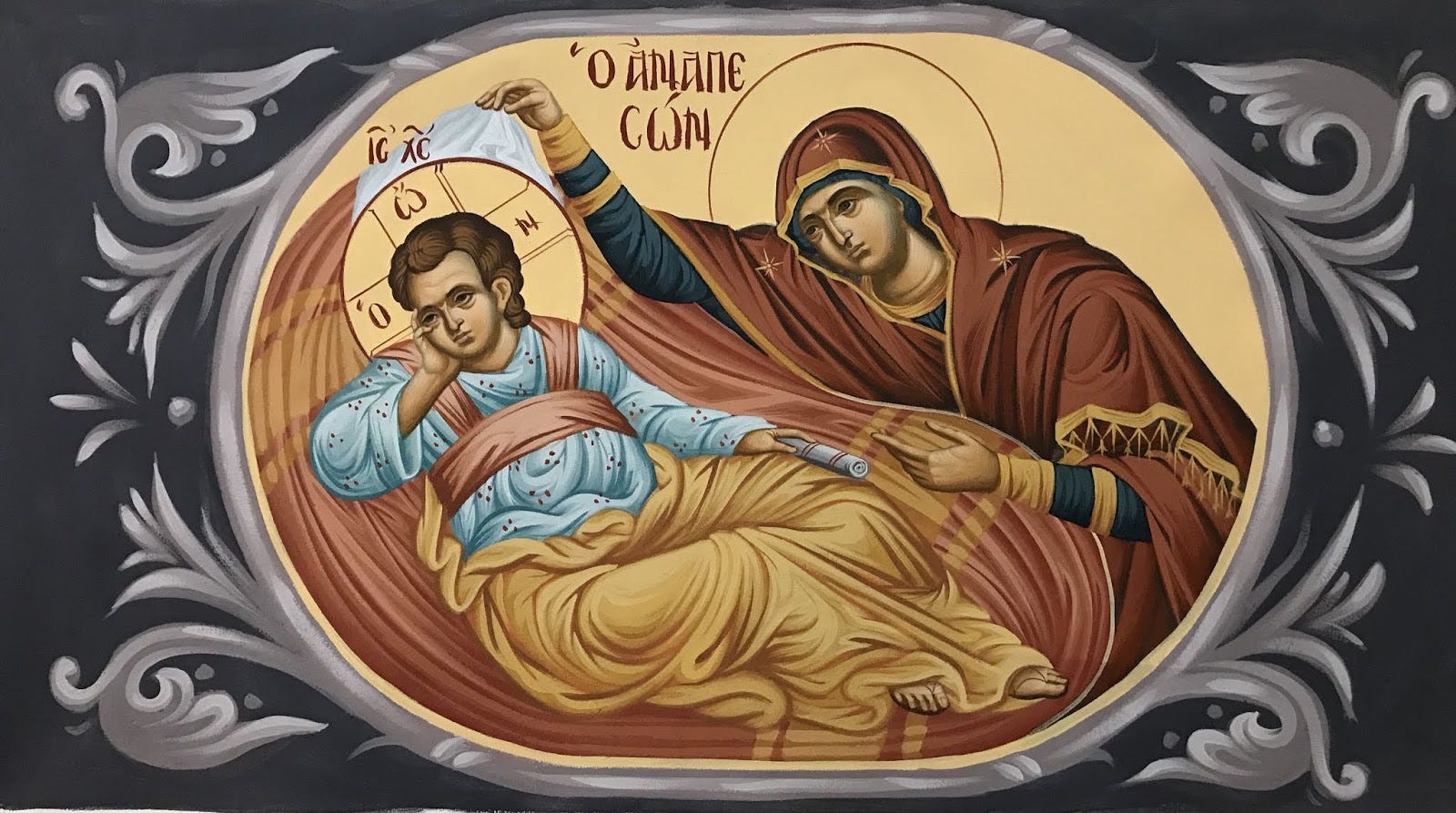
I have NEVER thought about Immanuel in the context of an event, or a series of events. What beautiful imagery - we see this throughout the Old Testament and then through Christ’s person in the Gospels. It gives us the ability to witness the events in our lives and reflect on God’s presence. When my dad passed away, I felt like my whole world had come undone. It was unexpected, and the way he died was tragic (to me). The following two years have been chaotic, heartwrenching, and absolutely life-altering. My brothers, who are barely believers, stare blankly at me when I tell them that God has been with me the whole time. When I look back and assess the events that I would honestly like to erase from my brain, I see God’s hand at work, making His presence known to me. I see His presence in events throughout my life and my family’s life, even before my dad’s passing. He is always with us, even when we can’t see Him clearly or feel Him in that moment.
How long, O Lord. Will you forget me forever? How long will You hide Your face from me?
Psalm 13:1
This was the Psalm reading for last night’s Vespers. Today’s Gospel reading was about Zacharias and the annunciation of John the Baptist. Many of the reflections I’ve read explain that Zacharias, as a Levite priest, possessed the knowledge from his scripture memorization that God's ways are not our ways; His timing is outside of our own. I examined what that means in the context of God with us as an event(s) in our lives.
Both the Psalm and the Gospel remind us to seek God, and when we seek Him, to wait with Him. He is with us, and though what we seek may not occur in our own timing, He understands us better than we realize, or are willing to admit. He took what is ours to give us what His, and because of this, He knows the desires of our hearts, the frustrations, the sadness, the heartache, the weight of our burdens, and how hard this all is in our fallen states. I think now I finally understand the meaning behind Matthew 11:28-30
Come to Me, all you who labor and are heavy laden, and I will give you rest. Take My yoke upon you and learn from Me, for I am gentle and lowly in heart, and you will find rest for your souls. For my yoke is easy and My burden is light. (Emphasis mine).
I will admit that sometimes I forget this, and I had a moment a couple of weeks ago when I allowed despondency to overcome my heart. I kept questioning Him and His purpose for me. My sadness blinded me, and I couldn’t see past my mistakes and feelings of worthlessness. Because I love you, He repeated to me. Whenever I offer these feelings of despondency during confession, I am sometimes told to put it all on the altar. Give it to the One whose yoke is easy and burden is light. Let Him give me the deep rest my soul desires. Like Eusebius of Caesarea states, “Rather, call upon Immanuel, the God who will “be with” people at the appropriate time. Take heart with confidence, trusting in the power of the title…”
I reflect on this even further as families again mourn the loss of their loved ones due to gun violence. Surely, Christ didn’t experience gun violence - how could He relate to those suffering from this terror? How could He allow this? I don’t know, but I do know He loves us so deeply. I can’t wait for the day when “God will wipe away every tear from their eyes; there shall be no more death, nor sorrow, nor crying. There shall be no more pain, for the former things have passed away.” Then He who sat on the throne said, “Behold, I make all things new.” Revelation 21:4-5. It is the eschatological hope I carry, and what reminds me repeatedly, “Because I love you and I am with you.” It is the promise He gave the apostles, the Theotokos, and all the witnesses at His ascension, “I am with you always, even to the end of the age.” Matthew 28:20
I am thankful for this contemplative Advent season. It’s not an easy one, but it is forcing me out of my comfort zone and pushing me to examine God with me, my family, my neighbor, and my community.
We barely got through the devotional this evening. Between a POTS flare up, an extra tired 4 year old, and my inability to regulate an already fried nervous system, I ended up switching places with my husband. It’s a learning process, and I share this to reflect the reality of trying to integrate these spiritual times into family life. It’s not always Instagram worthy. I’m very much OK with that.
Beautiful! This reminded me of a Catholic Bible teacher I used listen to - he was talking about Jesus weeping at Lazarus’ grave, and why was he crying when he knew he would raise Lazarus, and he said, “I think it’s simple. He cried for the whole damn mess.”
I do hope your four year old enjoys the picture book guide! If he's in the hating everything about church outside of church mode, then it really is perfect for him.
Your thoughts about grief made me think about the ways in which women in particular are tasked with the ministry of grief - the visits, the casseroles, wearing black in Middle Eastern culture; in Judaism, "sitting shiva"; in pre-Christian times until even now, the wailers - and it makes me think that this, as an experience you are going through now, might also be a chance for you to contemplate what an Orthodox Christian ministry of grieving could be in a world that doesn't really stop for grief the way our communities used to.